Core Conclusion: Scientific Weight Reduction Translates to Legal Payload Profits
With highway weight restriction regulations becoming increasingly stringent globally, blindly thickening the main beam only ineffectively eats away at legal payload capacity. Through Finite Element Analysis (FEA)-based "web cut-out lightweight design," we can precisely remove excess metal in the "Neutral Axis" area where main beam stress is minimal. This not only reduces the heavy-duty chassis tare weight by 10% to 15% but also retains 100% of the Q690 high-tensile steel main beam's bending and torsional rigidity. The weight saved is directly converted into legal, profitable payload per trip.
Debunking the "Heavier is Stronger" Myth: The Physics of Main Beam Stress
Many traditional fleet owners believe that the denser and heavier the steel on the beam, the less likely the trailer is to break. This is a massive cognitive blind spot in modern engineering mechanics.
When an I-beam is subjected to an 80-ton heavy-duty bending load, its stress distribution is not uniform:
-
Top Flange: Bears immense compression stress.
-
Bottom Flange: Bears immense tension stress.
-
Web Center: At the vertical center height of the I-beam, there is a physical "Neutral Axis." The bending stress here is almost zero, bearing only a certain amount of shear force.
Retaining a large amount of solid steel on this neutral axis contributes nothing to increasing bending strength; instead, it adds pointless Tare Weight, wasting valuable legal road right allowances.
Rejecting Blind Hollowing: HUAYUE's Engineering Standards for Lightweight Cut-Outs
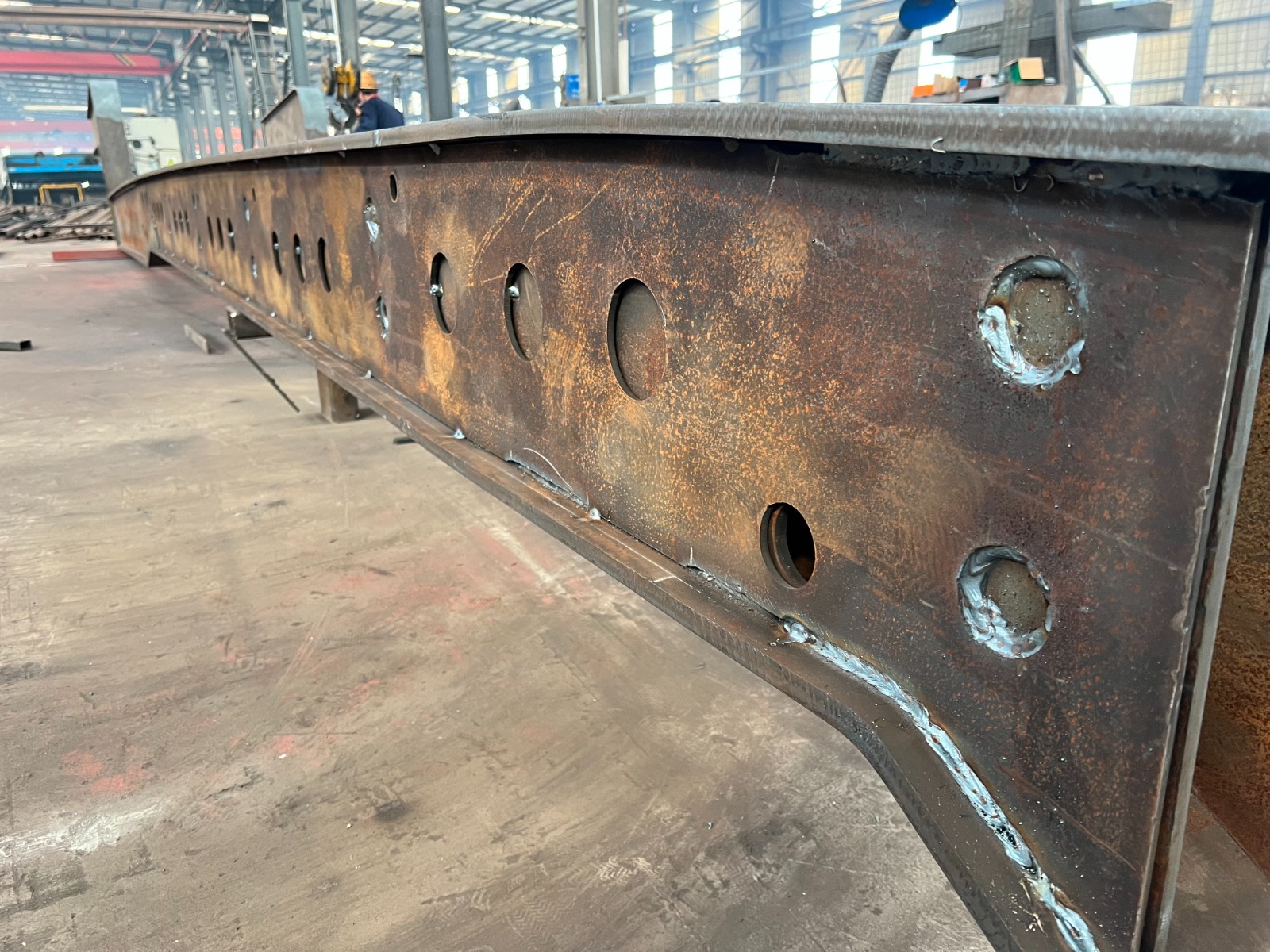
Cheap, ordinary factories often arbitrarily use gas cutting to carve holes in the web just to reduce weight. This brutal operation directly causes the beam to tear under heavy loads. Our lightweight cut-out process adheres to strict manufacturing standards:
| Manufacturing & Mechanical Evaluation | Traditional Workshop Hollowing | Traditional Workshop Hollowing |
| Cut-Out Positioning Calculation | Arbitrary cutting based on worker experience. | Relies on 3D Finite Element Analysis (FEA) via CAE software to avoid stress concentration zones. |
| Cutting Process | Manual gas cutting; rough edges with heat-damaged micro-cracks. | Laser/plasma CNC cutting; absolutely smooth edges with no heat-affected zone embrittlement risk. |
| Hole Edge Stress Treatment | Untreated; hole edges directly become fatigue fracture origins. | Utilizes high-frequency flanging or fully welded high-tensile reinforcing rings. |
| Torsional Performance | Highly susceptible to irreversible torsional deformation on rugged roads. | Perfectly maintains overall chassis rigidity; torsional resistance is fully equivalent to a solid web. |
Customized Solutions for Any Scenario
In the balancing act between extremely low tare weight and heavy-load rigidity, we provide global clients with Customized Solutions for Any Scenario:
-
For standard-load container/machinery fleets operating long-term on smooth highways, we provide an extreme elliptical cut-out lightweight matrix to push legal payload capacity to the absolute limit.
-
For special operational environments requiring frequent off-roading, such as forestry and mining, we customize a hybrid stress solution with lower cut-out density but thicker reinforcing rings to ensure lateral torsion resistance.
-
We offer customized alternative solutions using higher yield strength materials (e.g., T700 titanium alloy high-tensile steel), combining thinner flanges and webs with scientific cut-outs to achieve double weight reduction.
HUAYUE's Advantages
True lightweighting is not cutting corners; it is the deep integration of computing power and metallurgical engineering. HUAYUE's Advantages lie in completely abandoning outdated "heavy and clumsy" manufacturing mindsets. We use aerospace-grade finite element stress analysis technology to help you shave off every kilogram of useless dead weight in the workshop, ensuring that every legal weigh-in on the highway translates into tangible net financial profit.
Frequently Asked Questions
Q: With such large holes in the web, will the main beam sag after long-term transportation of crawler excavators?
A: Absolutely not. The core force resisting sagging (bending moment) comes from the thick top and bottom flanges, not the web center. The cut-out areas are located on the neutral axis where stress is minimal. Coupled with the high yield characteristics of the Q690 material we use and our pre-camber technology, the beam's anti-sagging rigidity is not diminished; instead, it gains better mechanical elasticity due to the reduced tare weight.
Q: Since cut-outs can reduce weight, why are some sections of the web solid with no holes?
A: This is an extremely rigorous mechanical design. The gooseneck transition connecting the main beam to the prime mover, as well as the connection points of the rear axle suspension, are the extreme "stress concentration zones" bearing the maximum shear and torsional forces of the entire chassis. In these core areas, not only do we refrain from cutting holes, but we actually thicken the web and add double vertical plates to ensure absolute heavy-load safety at the chassis's most vulnerable joints.
--------------------------------------------------
HUAYUE Trailer
—— Manufacturing Hardcore Equipment, Delivering Global Trust From custom R&D to cross-border after-sales support, HUAYUE provides global logistics companies with more than just semi-trailers—we deliver the absolute confidence to overcome any unexpected challenge.
📧 Get Exclusive Engineering Drawings & Quotes: info@hysemitrailer.com
🌐 Explore More Real Delivery Cases: https://hysemitrailer.com/
📞 WhatsApp / WeChat: +86 18963449574
Interested in this case?
Contact Us for a Technical Consultation.